
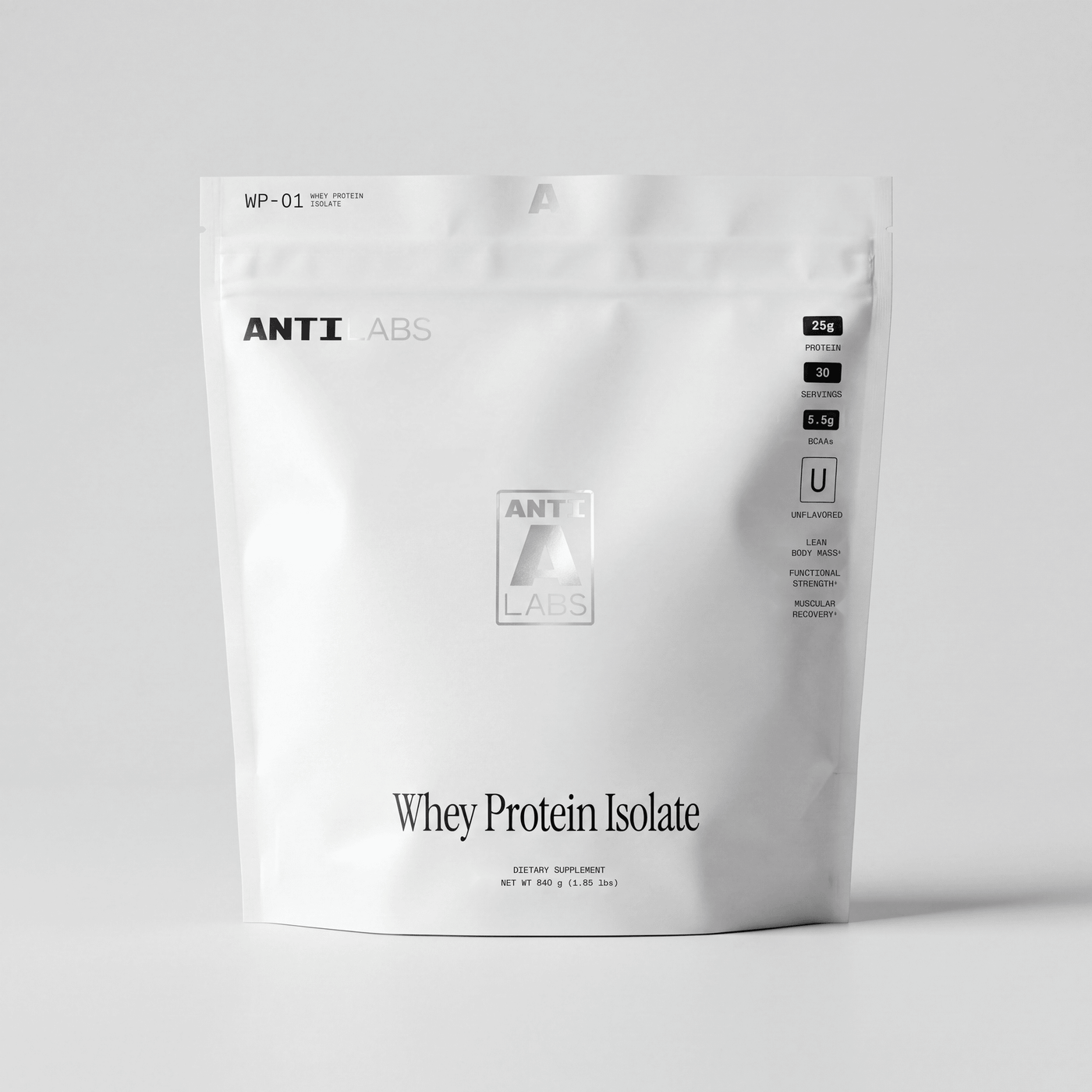
WP-01Whey Protein Isolate


(9 reviews)
Whey Protein Isolate
$1.85/serving subscribed30 servings
Cold-processed whey protein isolate from grass-fed herds never treated with rBST/rBGH. Mixes smoothly; taste is mild and clean. Two ingredients.
- 25 g protein per 28 g scoop
- Cold-filtered isolate, never heat-denatured
- Tested for heavy metals and contaminants
- Ships By Next Business Day
- 30-Day Satisfaction Guarantee
Latest batch
Whey Protein Isolate
WP-01
03 JUN 2026
03 JUN 2026
IdentityPass
Heavy MetalsPass
MicrobialPass
1
ScoopDaily
The standard protocol.
25 g whey protein isolate, with 5.5 g BCAAs and enough leucine to clear the leucine threshold. Any time of day; after physical activity is a natural window, but not required.
1.5
ScoopsDaily
The enhanced protocol.
For higher protein targets (≥ 1.6 g/kg bodyweight), heavy training cycles, or sessions over 90 min. Delivers 37.5 g protein in a single serving.
2
ScoopsDaily
Caloric restriction.
For periods of reduced calorie intake when hitting protein from whole food is harder. 50 g daily protects lean mass and satiety.‡
How to take it
Mix 1 scoop (28 g) with 8–12 oz water, milk, or oat milk, or blend into a shake. Very low in lactose by isolation — sits well even for sensitive stomachs. Taste-neutral by design.
Formulated by Aaron Esagoff, MD.
Cleared unanimously by nine independent board physicians — Jan 2026.
Hopkins · Harvard · Stanford · Mayo · UCSF · Penn · GW · Iowa
The record behind it
300+
Randomized human trials
25
Independent meta-analyses
Clinically studied since 1997
Every lot is produced under strict cGMP controls in FDA-registered facilities and tested for identity, heavy metals, and microbial safety before release. Test results are available for each batch.
Finished product is held in temperature-controlled storage and shipped from a climate-controlled facility, in sealed, tamper-evident packaging.
- NSF GMP certified facility
- SQF certified facility
- FDA 21 CFR Part 111 compliant
- Physician-formulated, panel-reviewed
- Third-party tested — every batch
- Clinically studied protein
- True whey isolate — very low in lactose, FSSC 22000-certified source
What's in it
- Whey protein isolate (cold-filtered, undenatured) — 25 g protein per scoop
- Sunflower lecithin
Contains: milk.
What's not in it
- No fillers or bulking agents
- No flavors
- No sweeteners
- No dyes or colorants
- No soy (sunflower, not soy)
- No proprietary blends
- No added sugar
- No gluten
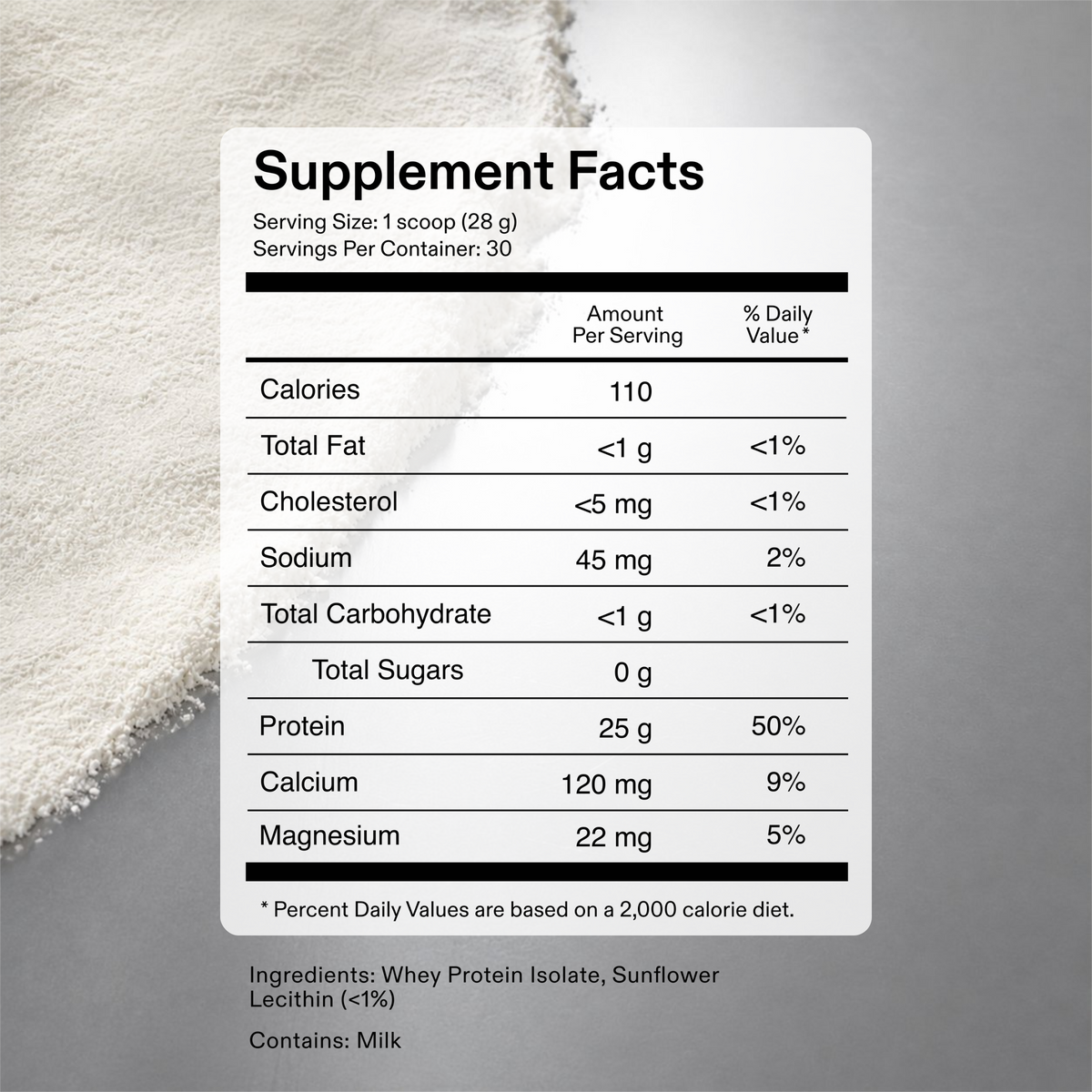
Serving Size: 1 scoop (28 g)
Servings Per Container: 30
| Nutrient | Amount Per Serving | % Daily Value |
|---|---|---|
| Calories | 110 | |
| Total Fat | <1 g | <1% |
| Cholesterol | <5 mg | <1% |
| Sodium | 45 mg | 2% |
| Total Carbohydrate | <1 g | <1% |
| Total Sugars | 0 g | |
| Protein | 25 g | 50% |
| Calcium | 120 mg | 9% |
| Magnesium | 22 mg | 5% |
* Percent Daily Values are based on a 2,000 calorie diet.
Ingredients: Whey Protein Isolate, Sunflower Lecithin (<1%).
Contains: Milk.
These statements have not been evaluated by the Food and Drug Administration. This product is not intended to diagnose, treat, cure, or prevent any disease.

Formulated by the founder. Signed off by the board.
Johns Hopkins
Harvard Medicine
Stanford Medicine
UCSF
Penn Medicine
Isolate, not concentrate — which means very low lactose. For my lactose-intolerant patients who want a clinical-grade protein, WP-01 is the one.

The supplement industry's bias is toward complexity. But the clinical literature is rooted in simplicity—single compounds, validated forms, consistent doses. ANTI is grown from the literature side.

Unlike concentrate, whey isolate undergoes additional filtration to remove excess carbohydrates and lactose, leaving a cleaner, more bioavailable protein.


Frequently Asked Questions
Why isolate instead of concentrate?
Purity. Retail concentrate runs about 70–80% protein; the remainder is fat, carbohydrate, and lactose. Isolate is filtered to 90% protein or higher, and the reference composition tables put it near 0.5% lactose and 0.5% milk fat, against 10–55% lactose and 2–10% fat for concentrate. WP-01 is cross-flow microfiltered to ≥90%. That's why it's very low in lactose — and why people who don't tolerate concentrate often handle isolate without trouble.
Why does it cost what it does?
Whey protein isolate is the most expensive form of whey to produce, and it earns the price: a complete essential amino acid profile, top scores on the standard protein-quality indices, and at least 90% protein by weight after cross-flow microfiltration. On top of that, we re-verify every incoming lot and pay an independent lab to test every batch. There are also no cheap ingredients in the pouch to bring the cost of goods down, since we skip the fillers, flavors, and sweeteners entirely.
The useful way to compare protein prices is cost per gram of protein. A lot of tubs look cheaper because they hold fewer servings, or put fewer grams of protein in each scoop, so the sticker price is lower while the protein itself costs more.
A pouch of WP-01 holds 750 g of protein (25 g across 30 servings). At $74 one-time, that comes to about 9.9¢ per gram of protein. With a subscription it's about 7.4¢ per gram on your first order and about 8.9¢ on renewals.
When should I take it?
Any time of day works. After physical activity is a good window: muscle protein synthesis stays elevated for roughly 24 hours post-exercise, and getting protein in feeds that response. Still, the research is consistent that your total daily protein matters far more than the timing of any single shake, so hit your daily target first.
I'm lactose intolerant. Can I take it?
Yes, and that's one of the reasons WP-01 exists. It's a true isolate, not a concentrate: cross-flow microfiltration strips out nearly all of the lactose, leaving under a gram per serving (a glass of milk carries roughly twelve). People who can't tolerate concentrate or milk routinely handle WP-01 without GI trouble. If your intolerance is severe, start with a half-scoop.
How much protein should I be eating daily?
For active adults, the literature lands around 1.6–2.2 g/kg per day. WP-01 gives you 25 g a scoop. For a 75 kg adult, one to two scoops usually closes the gap between what you eat and where you want to land. It is a tool to top up real food, not a replacement for it.
Why no flavors, sweeteners, or thickeners?
Every additive is a tradeoff. Sweeteners aren't universally tolerated; gums add fermentation load to the gut; and most flavoring is there to cover for low-quality whey. Ours has nothing to cover. Protein, lecithin, nothing else. Add flavor at the blender if you want it.
Why does WP-01 contain lecithin?
For mixability. Whey isolate clumps in cold liquid without an emulsifier; lecithin breaks the surface tension so the powder disperses instead of floating in lumps. We use a minimal amount, under 1% of the formula, GRAS-classified, and a source of phosphatidylcholine, the precursor your body uses to make choline. It is the one additive that does real work here.
Is high-protein intake (1.6–2.2 g/kg/day) safe in patients with normal renal function?
In adults with normal baseline renal function (eGFR ≥60 mL/min/1.73 m²), higher-protein intake has not been shown to accelerate renal decline; a systematic review and meta-analysis found no adverse effect of high-protein diets on GFR in healthy adults. The concern is extrapolated from CKD-specific data and does not apply to this population. Individualize intake in patients with established CKD, proteinuria, or a solitary kidney before recommending supplemental whey.
Is whey supplementation safe in patients with hepatic steatosis (NAFLD/MASLD)?
In obese, non-diabetic women, whey supplementation did not worsen hepatic steatosis or metabolic markers. The Bortolotti trial (Clin Nutr, 2011) reported that intrahepatocellular lipid fell ~21% over four weeks, alongside reductions in fasting triglycerides (~15%) and total cholesterol (~7%), with no adverse effect on glucose tolerance or creatinine clearance. Evidence in decompensated cirrhosis is lacking, so individualize there.
What about grass-fed and hormone-free claims?
Yes, our cows are grass-fed and never treated with rBST or rBGH.
But: for whey protein isolate, those labels are largely cosmetic. Bovine growth hormone doesn't survive pasteurization or your stomach, and the fatty-acid differences between grass-fed and grain-fed milk are filtered out during isolation. What's left is 90%+ protein, biochemically indistinguishable.
What actually matters here is on every batch's third-party COA: purity, dose accuracy, heavy metals, microbial load.
What is the evidence for whey in weight management for patients with obesity?
A meta-analysis of nine RCTs in overweight and obese adults found whey supplementation produced significant reductions in body weight and fat mass, with improvements across several cardiovascular risk markers: systolic and diastolic blood pressure, fasting glucose, HDL, and total cholesterol. Best positioned as an adjunct to a structured, energy-restricted, resistance-training program rather than a standalone intervention.
Protein dosing for older adults with sarcopenia or anabolic resistance?
Adults >65 show blunted muscle protein synthesis at standard doses; PROT-AGE consensus recommends 1.0–1.2 g/kg/day (1.2–1.5 g/kg in acute or chronic illness), distributed as 25–30 g of a leucine-rich source like whey per meal.
How do subscriptions work?
Your first subscription order is 25% off (15% on the every-two-months option). Every order after that is 10% off. Subscriptions ship free, automatically, and you can skip, pause, or cancel anytime, for any reason, right from your account.
What's your return policy?
Every order is covered by a 30-day guarantee. If you're not satisfied, return it within 30 days of delivery for a refund or replacement — for any reason. Full details are in our Refund Policy.
How fast do you ship, and where?
We ship within the United States. Orders ship from our US fulfillment center within 1 business day.
Are your products third-party tested?
Yes — every batch is third-party tested, and you can look up the results by lot.
Where are your products made?
In an NSF- and UL-registered, SQF-certified GMP facility in the US.
How do you decide what to sell?
We review ingredients rigorously and publish our reasoning in the Formulary — we only sell what we'd take ourselves. Of the ingredients we've reviewed, we've rejected 95%.
5.0
★★★★★
★★★★★
Based on 9 reviews
5
4
3
2
1
AI-powered review summary
Customers rate WP-01 five stars, calling it “a world-class protein that fills a daily need.” Reviewers praise how cleanly the unflavored isolate mixes into shakes, smoothies, and coffee, with no grit, no sweeteners, and no aftertaste. They point to the quality of the grass-fed, cold-processed isolate, the 25 g of protein in every serving, and the third-party testing behind every batch. Lactose-sensitive customers report it sits easy, athletes credit it for recovery and strength, and nearly everyone says they'd recommend it.
Customers Talked About
Excellent product. The whey protein itself was high quality, and was noticeably easier on my stomach than many others I’ve tried. I also appreciated the clean formula without a long list of unnecessary additives. The portion size was just right, and the packaging felt premium, practical, and easy to reuse. I would definitely order it again.
I love this protein! As a lactose intolerant and someone with a sensitive stomach, I am not able to tolerate most whey proteins and plant proteins. This whey protein ACTUALLY has functionally no lactose. I can take it every day with no gas or bloating. It was an important part of the process of losing my baby weight post partum and helped me meet my goals.
Loving this. I'm recovering faster from my workouts, feeling stronger, and eating better since I started using the creatine and whey protein products from AntiLabs. Definitely the best supplement brand that I have found so far. And it's such a relief not having to stress about the fillers and junk that the other brands hide in their products. Highly recommend.
10/10, you can taste the quality, I mix in some warmed oat milk in the morning and it tastes amazing
Love the flavor and clean ingredients!
This is the real deal. Best ingredients make the best products.
Buy with confidence. highly recommend.
A world class protein that fills a daily need. I would highly recommend.
Complete your protocol
Finish the stack.
 CM-01
Creatine Monohydrate
5g per serving · unflavored
CM-01
Creatine Monohydrate
5g per serving · unflavored
Supports
Protein
+ CM-01
Lean Muscle Mass
Maximal Strength
Cognitive Benefits
Neuromuscular Performance
Phosphocreatine Availability

I start every morning with ANTI Labs protein and creatine. It's the highlight of my morning routine.